(765) 358-7002
GET FREE QUOTE
SERVICE ENTITY · SPECIALTY & YEAR-ROUND

Pole Barn Floor Installation Anderson IN

Most pole barn floors fail because they were poured the same way as a residential driveway — without accounting for the pole posts, without a vapor barrier, and without isolation joints at every structural column. We pour pole barn and agricultural shop floors on a 6-inch compacted stone base with a vapor barrier, 4000 PSI mix with fiber mesh or rebar depending on expected loads, and full-depth isolation joints around every post so the slab can move independently without cracking at the post interface. Shop floors, equipment storage, agricultural buildings, and hobby workshops. Fixed-price quote within 48 hours.

Anderson Pendleton Noblesville Fishers Carmel Westfield Zionsville
Pole Barn Floor Specifications
Mix
4000 PSI · air-entrained if door openings exposed
Thickness
4" light use · 5–6" tractor or heavy equipment
Base
6" #53 stone compacted to Standard Proctor density
Vapor Barrier
10-mil polyethylene · lapped and taped
Reinforcement
Fiber mesh (light use) · #4 rebar (equipment loads)
Post Isolation
Full-depth isolation joint around every structural post
Control Joints
Every 10–15 ft · connecting post isolation joints
Warranty
60-day workmanship
01 · Design

The post isolation joint — the detail that determines whether the floor lasts.

A pole barn is a post-frame structure — the posts are embedded in the ground and carry the roof load directly. The concrete floor is a slab-on-ground that fills the space between the posts. These two structural elements move independently: the posts move with the soil and the building loads; the slab moves with temperature, moisture, and subgrade conditions. If the slab is poured monolithically against the posts — no isolation joint — the differential movement cracks the slab at every post location. That's the most predictable concrete failure mode in agricultural construction.

The fix is a full-depth isolation joint around every structural post, formed with 1/2-inch foam board before the pour. The slab terminates against the foam, not against the post. The posts float through the slab without transferring their movement into the floor. Control joints then connect the post isolation joints to create a rational joint pattern that guides any shrinkage cracking along the joint lines instead of across the open floor.

Air entrainment at door openings

Pole barn floors at sliding door openings are exposed to freeze-thaw cycling — the slab right at the door threshold sees outdoor temperature and moisture during open weather. That zone should be air-entrained. If the entire floor is poured in one shot, we can use air-entrained mix throughout with no downside for the interior. If the client prefers non-air-entrained for the interior for density reasons, we discuss the door zone treatment on the estimate visit.
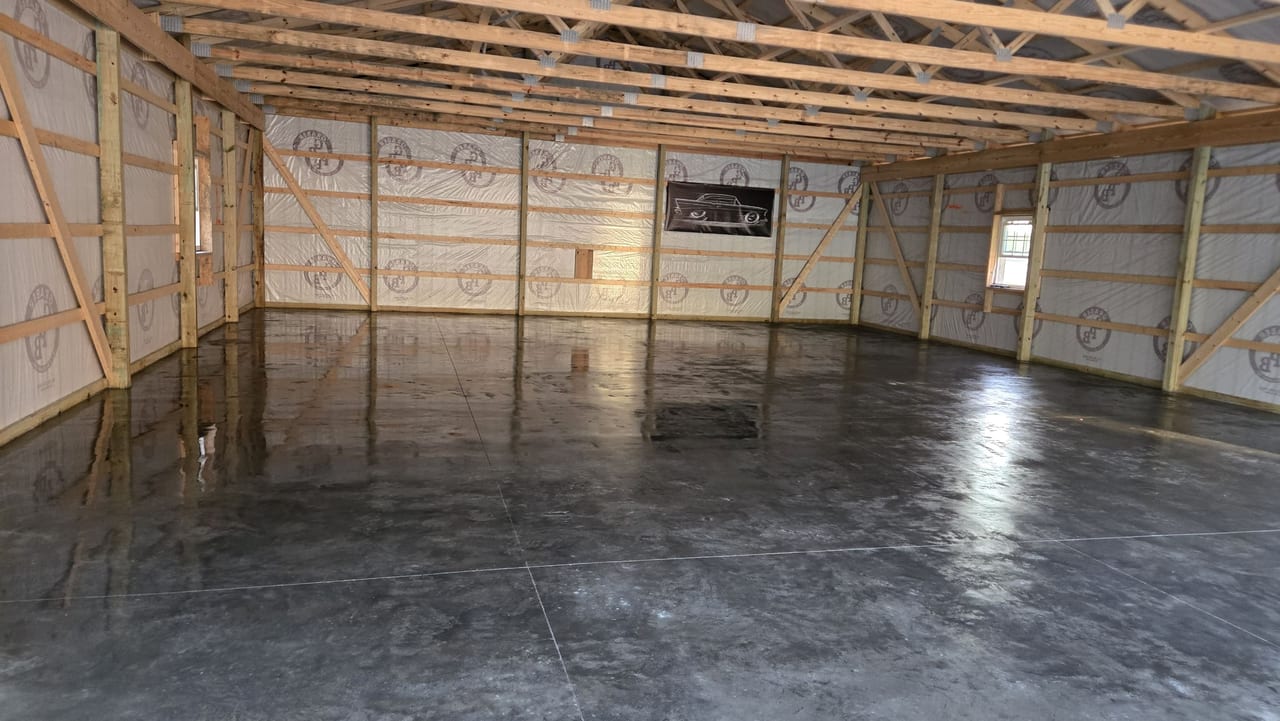
Large-scale pole barn concrete floor with power float finish showing control joint grid, Madison County Indiana
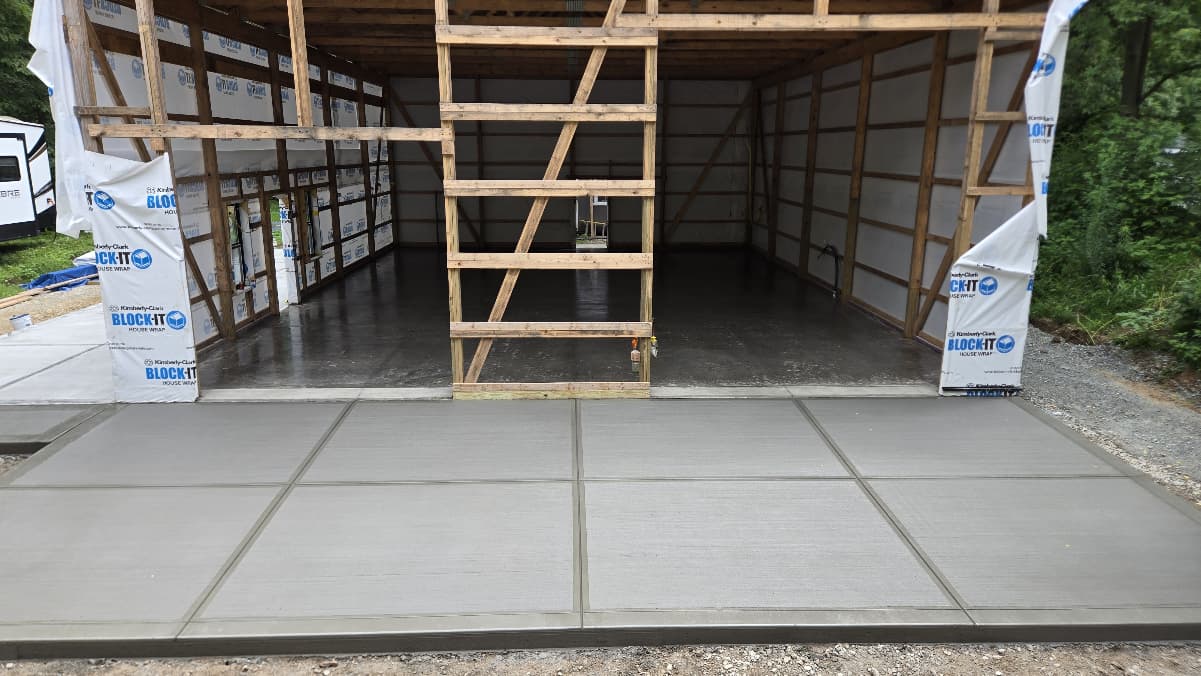
Broom-finished concrete apron at pole barn entry with control joints, Madison County Indiana
02 · Spec Sheet

Every pole barn floor we pour.

Concrete Mix
4000 PSI · air-entrained 5–7% if freeze-thaw exposure at door zones
Thickness
4" hobby shop / light storage · 5" regular tractor or skid steer · 6" heavy equipment
Base Course
6" #53 INDOT stone compacted to Standard Proctor density · proof-roll for soft spots
Vapor Barrier
10-mil polyethylene · lapped 12" at seams · taped · turned up at perimeter posts
Reinforcement
Polypropylene fiber mesh for light use · #4 rebar at 18" O.C. for equipment loads
Post Isolation
1/2" foam board full-depth around every structural post before pour
Control Joints
Tooled or saw-cut at 10–15 ft O.C. · connect post isolation joints to create rational panel grid
Door Threshold
Isolation joint at door track channel · approach apron air-entrained and sealed
Surface Finish
Broom finish standard · power trowel for smoother finish on shop/workspace floors
03 · Process

Six steps, start to finish.

Most pole barn floors complete in 2 days — one day for base prep, post isolation, and vapor barrier; one day for the pour. Large buildings (5,000+ sq ft) may require 2 pour days depending on truck sequencing and crew size.

01

Estimate & Load Confirm

Measure floor area, confirm use (hobby shop, tractor storage, livestock equipment, etc.), confirm heaviest equipment that will use the floor. Determine thickness and reinforcement. Fixed-price quote within 48 hours.

02

Grade & Base Prep

Grade subgrade to uniform level with drainage slope to door (approximately 1/8" per foot). Place 6" #53 stone, compact to Standard Proctor density. Verify elevation at all posts and wall perimeter.

03

Post Isolation & Vapor Barrier

Install 1/2" foam isolation board around every structural post, full depth. Lay 10-mil poly vapor barrier, lapped and taped. Turn up at post isolation boards and perimeter.

04

Reinforcement & Forms

Place fiber mesh or rebar per spec. Set edge forms at door openings to door track elevation. Mark control joint locations connecting post isolation boards.

05

Pour & Finish

4000 PSI mix placed, consolidated, and screeded. Broom or power trowel finish. Control joints tooled before final set — connect post isolation boards as planned.

06

Cure & Closeout

Curing compound applied. Light foot traffic at 24 hours. Tractor or equipment use at 7 days. 60-day workmanship warranty issued.

04 · Local Notes

Pole barn floor conditions across our service area.

Pendleton & Anderson: Rural Madison County has the highest concentration of pole barn projects in our service area — hobby farms, hobby shops, equipment storage, and small agricultural operations. Many older barns have dirt floors or old cracked pours without vapor barriers. We see frequent replacements or new pours tied to barn renovation projects.

Westfield & Noblesville: Semi-rural properties transitioning from agricultural to residential use often have existing pole barns being converted to workshops or finished hobby spaces. These projects require a finish-quality floor — power trowel finish, clean control joints, and sometimes a penetrating sealer for dust control.

Fishers & Carmel: Detached workshop buildings in subdivision properties are the common pole barn floor application here — post-frame workshop structures on residential lots. These are typically smaller (1,200–2,400 sq ft) and light-use — 4-inch thickness is usually sufficient.

05 · FAQ

What people ask before they call.

Do I need a permit for a pole barn floor?
If the pole barn itself required a permit, the floor is typically included in that permit scope. Pouring a floor in an existing permitted building usually doesn't require a separate concrete permit in most Indiana rural and suburban jurisdictions. Agricultural buildings may be exempt from permit requirements entirely under Indiana's agricultural exemption. We verify on the estimate visit for your specific city and parcel.
What thickness do I need for a tractor?
A compact utility tractor (under 50 hp, under 8,000 lbs) is handled by a 5-inch slab with rebar. Larger agricultural tractors over 10,000 lbs, skid steers, and small loaders should have 6 inches. We confirm the heaviest equipment on the estimate visit and spec accordingly — this is not a place to guess and come up short.
Why does the floor crack at the posts?
Because the posts and the slab move independently — the posts are tied to the building's frost footings or embedded in the ground; the slab rests on the subgrade. Seasonal ground movement, frost heave, and thermal cycling affect each differently. Without an isolation joint at every post, the differential movement cracks the slab at the post location predictably. We install foam isolation board around every post before the pour.
Should I seal a pole barn floor?
A penetrating silane/acrylic sealer reduces dust and prevents oil and chemical staining on shop floors. For agricultural use (livestock, feed, fertilizer), a penetrating sealer also reduces chemical attack on the concrete surface. It's optional but recommended for any shop or mechanical workspace. We can include application at the 28-day cure point.
Can I pour the floor before the pole barn is fully enclosed?
It's better to pour after the roof is on — unprotected concrete in Indiana weather during spring or fall can see temperature swings that affect curing. If the pour has to happen before enclosure, we schedule it with a weather window and use curing compound and temporary coverings. In winter, no pours in an unenclosed structure — concrete in a freezing environment requires enclosure and heating to cure properly.
06 · External

Spec validated by industry standards.

Our pole barn floor thickness, base preparation, and joint design follow ACI 302.1R "Guide for Concrete Floor and Slab Construction" and ACI 360R "Design of Slabs-on-Ground" for agricultural and light industrial floor applications. The post isolation joint requirement follows established post-frame building construction practice per the National Frame Building Association (NFBA) Post-Frame Building Design Manual.

REF · NFBA National Frame Building Association — Post-Frame Building Design Manual
FREE ESTIMATE · NO OBLIGATION

Tell us about your project.

The fastest way to a quote is a phone call. Prefer to send details instead? Fill in the form and we'll respond the same business day — usually within a couple of hours.

  • Same-business-day reply
  • Free on-site estimate
  • No high-pressure sales
  • Fixed-price written quote
— or call us directly —
▣ Tap to call · 7 days (765) 358-7002
Insured · Serving Anderson, Pendleton, Noblesville, Fishers, Carmel & Westfield
SECURE FORM · DELIVERED INSTANTLY

Got it. Thank you!

We'll be in touch shortly with your quote. Need it sooner? Call or text (765) 358-7002.

Redirecting…

Free pole barn floor estimate.
Post isolation and vapor barrier standard.

Tell us the building dimensions, the intended use, and the heaviest equipment that will use the floor. We'll spec the right thickness and hand you a fixed-price quote.