(765) 358-7002
GET FREE QUOTE
SERVICE ENTITY · RESIDENTIAL & HOME INFRASTRUCTURE

Concrete Patio Installation Anderson IN

Want a concrete patio that drains away from the house, holds up through Indiana winters, and doesn't look like it belongs in a parking lot? We pour outdoor slabs with proper grade, rebar reinforcement, and 4000 PSI air-entrained mix — plain broom finish or something more distinctive if you want it. Free on-site estimate, permits handled.

Anderson Pendleton Noblesville Fishers Carmel Westfield Zionsville
Service Specifications
Slab Depth
4" standard · 6" heavy load
Mix
4000 PSI air-entrained · SRM Ready Mix
Reinforcement
#4 rebar 16" O.C.
Drainage Slope
1/8"–1/4" per ft away from house
Base
4" #53 stone, compacted to Standard Proctor density
Cure
7-day light use · 28-day full
Warranty
60-day workmanship
01 · Engineering

The two things a concrete patio has to get right from day one.

A backyard patio sits right next to your house foundation — that proximity is both the point and the problem. Get the drainage slope wrong and the slab funnels rainwater and snowmelt toward your basement wall instead of away from it. Get the joint between the patio and the house wrong and any differential settlement between the two cracks both. These aren't rare failure modes. They're what we see on most of the patios we're called in to replace.

Every patio we pour slopes a minimum of 1/8 to 1/4 inch per foot away from the structure — enough to shed water clearly without feeling like you're sitting on a ramp. We set an isolation joint at the house foundation so the patio can move independently of the house without cracking either one. The subgrade gets excavated and compacted before base stone goes in, so there's no settling later from organic material or soft spots in Madison County's clay soils.

Why 4000 PSI on a patio that only sees foot traffic

An outdoor slab takes more punishment than it looks like. Indiana gets 60+ freeze-thaw cycles a winter — every one of those cycles forces water in and out of the surface pores. A lower-strength mix without air entrainment starts spalling within a few winters under that kind of cycling, even with no vehicle load whatsoever. The 4000 PSI air-entrained spec we use on driveways is the same one we use on patios, because the climate is the same climate. A patio that spalls in five years isn't a bargain at any price.

If you want stamped concrete, exposed aggregate, or a wood plank pattern rather than a broom finish, we handle those too — same structural spec underneath, different surface treatment. See our Stamped Concrete page for finish options.

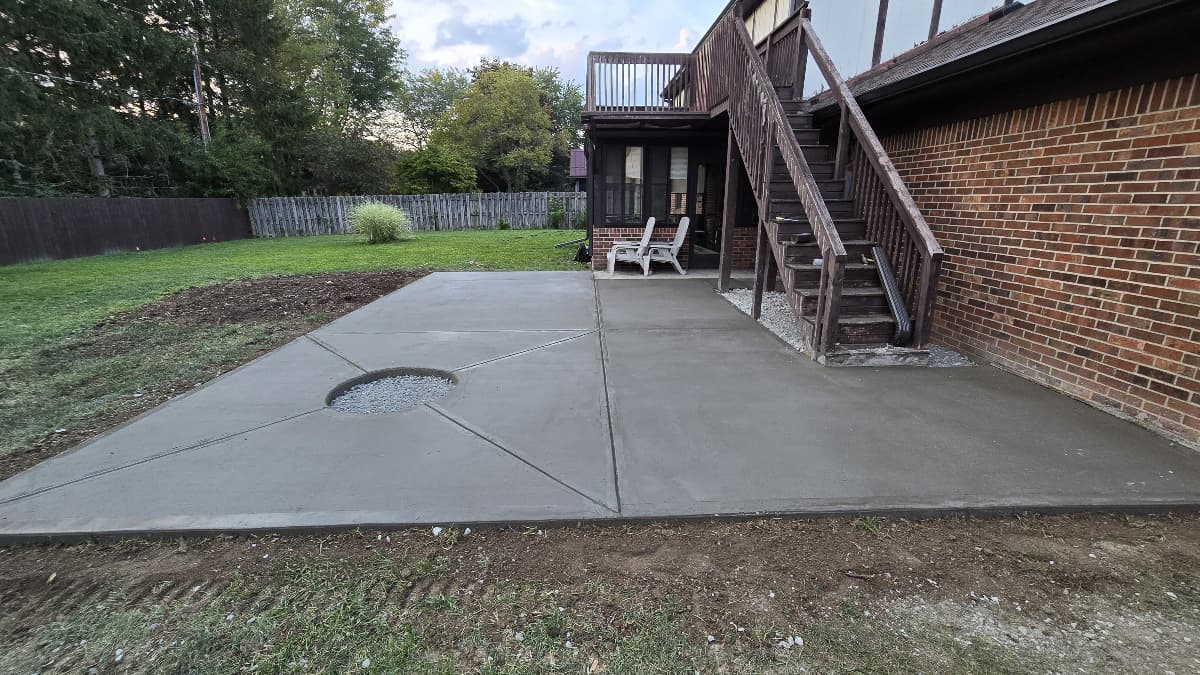
Broom-finished concrete patio with integrated drainage and control joints, Anderson Indiana
02 · Spec Sheet

Every patio we pour, every time.

Concrete Mix
4000 PSI · air-entrained 7%
Slab Thickness
4" standard foot-traffic · 6" where heavy furniture or hot tub load applies
Reinforcement
#4 rebar grid · 16" on center · chaired to slab mid-depth
Base Course
4" of #53 INDOT stone · compacted to Standard Proctor density
Drainage Slope
Minimum 2% (1/4" per ft) away from house foundation · per ACI 360R
Isolation Joint
Full-depth at house foundation wall · allows independent movement
Control Joints
Saw-cut at 8–10' O.C. · within 24 hours of pour
Finish
Light broom standard · stamped or exposed aggregate available
Curing
Curing compound day 1 · winter blankets when ambient < 40°F
Sealer
Acrylic applied day 1
03 · Process

From your backyard to a finished patio.

Most patio pours complete in 4–6 calendar days from permit clearance — prep and base on days 1–2, pour on day 3. Winter pours add a blanket cure window.

01

On-Site Estimate

We measure the layout, confirm the drainage slope relative to your door threshold, check for any impervious surface permit triggers, and write a fixed-price quote.

02

Permit & HOA

City permit pulled if required for new impervious surface. HOA approval coordinated in Carmel, Fishers, and Westfield subdivisions — we know the process and handle it.

03

Demo & Excavate

Old patio or sod removed and hauled off. Subgrade excavated to proper depth and graded at the correct slope away from the house.

04

Stone Base

#53 stone placed and compacted to Standard Proctor density. Soft spots in the clay subgrade addressed before base stone goes down.

05

Form & Reinforce

Forms set to finished elevation, rebar grid laid and chaired, isolation joint placed at the house foundation wall, fabric installed where the subgrade calls for it.

06

Pour & Finish

4000 PSI air-entrained mix placed, screeded to slope, and finished — broom, stamped, or aggregate, depending on what you picked at the estimate.

07

Saw-Cut Joints

Control joints cut within 24 hours of the pour at proper spacing. The patio cracks along those lines — not randomly across the field — as the slab cures.

08

Cure & Seal

Curing compound day 1. Acrylic sealer at day 28 once hydration is complete. You get a slab-spec sheet and a 60-day workmanship warranty.

04 · Local Notes

Permit and HOA notes for every city we serve.

Anderson: Most backyard patios in Anderson don't require a building permit unless they're attached to the house structure or exceed a certain square footage. We confirm the threshold on the estimate visit. Any work near the ROW line is a different matter — we check setbacks before we form.

Carmel: Carmel HOAs are thorough on hardscape additions. Most require a submitted site plan showing the patio footprint relative to the property line and the house before they'll approve work. We've put these packages together before — it's not as complicated as it sounds, just paperwork. Carmel also has impervious surface coverage limits in some neighborhoods; we calculate your lot's remaining coverage allowance on the estimate visit.

Fishers: Activity Permit required for patios above a certain square footage. HOA approval is standard in the planned communities throughout Fishers. Hamilton County's shallow clay layer can be soft under organics — we evaluate and address any subgrade issues before the base goes in.

Westfield: WeConnect portal for new impervious surface. Westfield's residential standards near Grand Park sometimes specify finish materials for outdoor hardscape — we confirm those requirements before finalizing your finish selection.

Noblesville & Pendleton: Older properties in Noblesville's established neighborhoods often have mature trees with root systems near the patio footprint. We evaluate root intrusion risk on the estimate visit — some situations call for a root barrier before the base goes in. Pendleton residential patios are generally straightforward; rural properties may have drainage considerations on larger slabs.

05 · FAQ

What people ask before they call.

How long until I can use my new concrete patio?
Light foot traffic at about 24 hours. Furniture and normal use at approximately 7 days. Full design strength and sealer application at 28 days. We'll give you the specific timeline when we hand off the job.
Do I need a permit for a concrete patio in Anderson or Hamilton County?
In Anderson, permits for backyard patios depend on square footage and whether the slab is attached to the house. In Carmel, Fishers, and Westfield, impervious surface permits are more common and HOA approval is almost always required. We confirm the specific requirements for your address on the estimate visit and handle every application.
What finish options are available for a concrete patio?
Broom finish is standard — slip-resistant and clean-looking. We also do stamped concrete in patterns like ashlar slate and wood plank, exposed aggregate, and sand matrix finishes for pool deck-adjacent areas. The structural spec is the same underneath regardless of what's on top. See our Stamped Concrete page for finish details and pricing considerations.
How do I keep my patio from cracking?
The right spec and proper joint placement handle most of it. We use 4000 PSI air-entrained mix and saw-cut control joints within 24 hours of the pour. Beyond that, keeping water from pooling on the surface (handled by the drainage slope we set at pour) and sealing the slab at 28 days covers the main cracking risks in Indiana's climate.
Can you connect the patio directly to my house foundation?
Yes, but we always set an isolation joint at the connection point — a full-depth break between the patio slab and the house foundation. Without it, if the patio and the house settle at different rates (which they will), the slab cracks at the bond point. The isolation joint lets them move independently. It's standard practice; don't let anyone talk you out of it.
Can you pour a patio in winter?
Yes. Hot water mix and curing blankets keep the slab above 40°F through the cure window when temperatures drop. We pour year-round in Madison, Hamilton, and Boone County. Winter pours add a couple days to the schedule; cost is comparable to a summer pour.
06 · External

Spec validated by industry standards.

Our patio drainage slope and slab-on-ground spec follows ACI 360R, the American Concrete Institute's Guide for Design and Construction of Slabs-on-Ground — the primary reference for residential outdoor concrete flatwork design in freeze-thaw climates.

REF · ACI American Concrete Institute — ACI 360R Guide for Design and Construction of Slabs-on-Ground
FREE ESTIMATE · NO OBLIGATION

Tell us about your project.

The fastest way to a quote is a phone call. Prefer to send details instead? Fill in the form and we'll respond the same business day — usually within a couple of hours.

  • Same-business-day reply
  • Free on-site estimate
  • No high-pressure sales
  • Fixed-price written quote
— or call us directly —
▣ Tap to call · 7 days (765) 358-7002
Insured · Serving Anderson, Pendleton, Noblesville, Fishers, Carmel & Westfield
SECURE FORM · DELIVERED INSTANTLY

Got it. Thank you!

We'll be in touch shortly with your quote. Need it sooner? Call or text (765) 358-7002.

Redirecting…

Free patio estimate.
We'll lay out the footprint and write a fixed price.

Tell us the rough size, the finish you're thinking about, and whether there's an HOA involved. We'll handle the rest from there.